


Refining posterior estimates with importance sampling#
Theory#
SBI estimates the posterior \(p(\theta|x) = {p(\theta)p(x|\theta)}/{p(x)}\) based on samples from the prior \(\theta\sim p(\theta)\) and the likelihood \(x\sim p(x|\theta)\). Sometimes, we can do both, sample and evaluate the prior and likelihood. In this case, we can combine the simulation-based estimate \(q(\theta|x)\) with likelihood-based importance sampling, and thereby generate an asymptotically exact estimate for \(p(\theta|x)\).
Importance weights#
The main idea is to interpret \(q(\theta|x)\) as a proposal distribution and generate proposal samples \(\theta_i\sim q(\theta|x)\), and then augment each sample with an importance weight \(w_i = p(\theta_i|x) / q(\theta_i|x)\). The definition of the importance weights is motivated from Monte Carlo estimates for the random variable \(f(\theta)\),
We can rewrite this expression as
Instead of sampling \(\theta_i\sim p(\theta_i|x)\), we can thus sample \(\theta_i\sim q(\theta_i|x)\) and attach a corresponding importance weight \(w_i\) to each sample. Intuitively, the importance weights downweight samples where \(q(\theta|x)\) overestimates \(p(\theta|x)\) and upweight samples where \(p(\theta|x)\) underestimates \(q(\theta|x)\).
Implementation#
import torch
from torch import eye, ones
from torch.distributions import MultivariateNormal

from sbi.analysis import marginal_plot
from sbi.inference import NPE, ImportanceSamplingPosterior
from sbi.utils import BoxUniform
We first define a simulator and a prior which both have a sample function (as required for sbi) and log_prob evaluations (as required for importance sampling).
Next we train an NPE model for inference.
Now we perfrom inference with the model.
# define prior and simulator
class Simulator:
    def __init__(self):
        pass

    def log_likelihood(self, theta, x):
        return MultivariateNormal(theta, eye(2)).log_prob(x)

    def sample(self, theta):
        return theta + torch.randn((theta.shape))

prior = BoxUniform(-5 * ones((2,)), 5 * ones((2,)))
sim = Simulator()
log_prob_fn = lambda theta, x_o: sim.log_likelihood(theta, x_o) + prior.log_prob(theta)

# generate train data
_ = torch.manual_seed(3)
theta = prior.sample((10,))
x = sim.sample(theta)

# train NPE model
_ = torch.manual_seed(4)
inference = NPE(prior=prior)
_ = inference.append_simulations(theta, x).train()
posterior = inference.build_posterior()

# generate a synthetic observation
_ = torch.manual_seed(2)
theta_gt = prior.sample((1,))
observation = sim.sample(theta_gt)[0]
posterior = posterior.set_default_x(observation)
print("observations.shape", observation.shape)

# sample from posterior
theta_inferred = posterior.sample((10_000,))

# get samples from ground-truth posterior
gt_samples = MultivariateNormal(observation, eye(2)).sample((len(theta_inferred) * 5,))
gt_samples = gt_samples[prior.support.check(gt_samples)][:len(theta_inferred)]
Neural network successfully converged after 70 epochs.observations.shape torch.Size([2])
In this case, we know the ground truth posterior, so we can compare NPE to it:
fig, ax = marginal_plot(
    [theta_inferred, gt_samples],
    limits=[[-5, 5], [-5, 5]],
    figsize=(5, 1.5),
    diag="kde",  # smooth histogram
)
ax[1].legend(["NPE", "Groud Truth"], loc="upper right", bbox_to_anchor=[2.0, 1.0, 0.0, 0.0]);
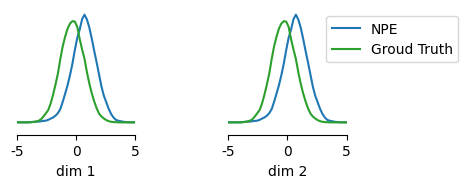
While NPE is not completely off, it does not provide a perfect fit to the posterior. In cases where the likelihood is tractable, we can fix this with importance sampling.
Importance sampling with the SBI toolbox#
With the sbi toolbox, importance sampling is a one-liner. sbi supports two methods
for importance sampling:
"importance": returnsn_samplesweighted samples (as above) corresponding ton_samples * sample_efficiencysamples from the posterior. This results in unbiased samples, but the number of effective samples may be small when thesbiestimate is inaccurate."sir"(sampling-importance-resampling): performs rejection sampling on a batched basis with batch sizeoversampling_factor. This is a guaranteed way to obtainN / oversampling_factorsamples, but these may be biased as the weight normalization is not performed across the entire set of samples.
posterior_sir = ImportanceSamplingPosterior(
    potential_fn=log_prob_fn,
    proposal=posterior,
    method="sir",
).set_default_x(observation)

theta_inferred_sir = posterior_sir.sample(
    (1000,),
    oversampling_factor=32,
)
fig, ax = marginal_plot(
    [theta_inferred, theta_inferred_sir, gt_samples],
    limits=[[-5, 5], [-5, 5]],
    figsize=(5, 1.5),
    diag="kde",  # smooth histogram
)
ax[1].legend(["NPE", "NPE-IS", "Groud Truth"], loc="upper right", bbox_to_anchor=[2.0, 1.0, 0.0, 0.0]);
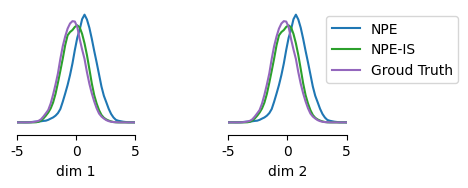
Indeed, the importance-sampled posterior matches the ground truth well, despite significant deviations of the initial NPE estimate.